

June 29, 2008
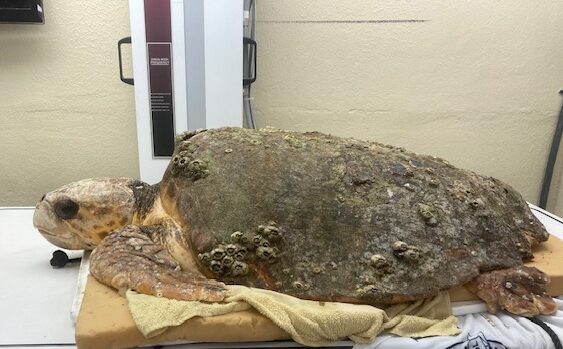
A sub adult Loggerhead Sea Turtle was found floating in the Ocean Reef area of Key Largo. The turtle was transported to the Turtle Hospital and upon having an incoming X-ray performed, the problem became apparent. The digestive tract is impacted, the bloated intestines clearly showing on the X-ray image . In addition to antibiotics and vitamins, laxatives will also be administered.
The Florida Keys Sea Turtle nesting season is in full swing. Officially starting on April 15 (running through Oct 31) there have been a number of nests identified and several that have already hatched. Save-A-Turtle coordinates the monitoring of beaches in the Keys, hosting annual training sessions by the FWC and scheduling daily “beach walks” by volunteers. Each year the Turtle Hospital receives hundreds of hatchlings that became disorientated due to improper lighting in the area, ones that did not make it out of the nest (found when nest is inventoried after hatching), hatchlings that got trapped or tangled in vegetation or trash on the beach and others that were attached by birds, crabs ants etc. The baby turtles are placed in special “hatchling tanks” where they are monitored and fed. Once the hatchlings are eating on their own (finely cut squid tentacles), staff will take them out to the Gulf Stream and place them in patches of Sargassum seaweed which is where they would normally swim to. Hatchlings that do not eat on their own or that have other physical problems are held and treated until being releasable.
Two hatchlings from a nest on Sombrero Beach in Marathon, currently in our care.
June 25, 2008
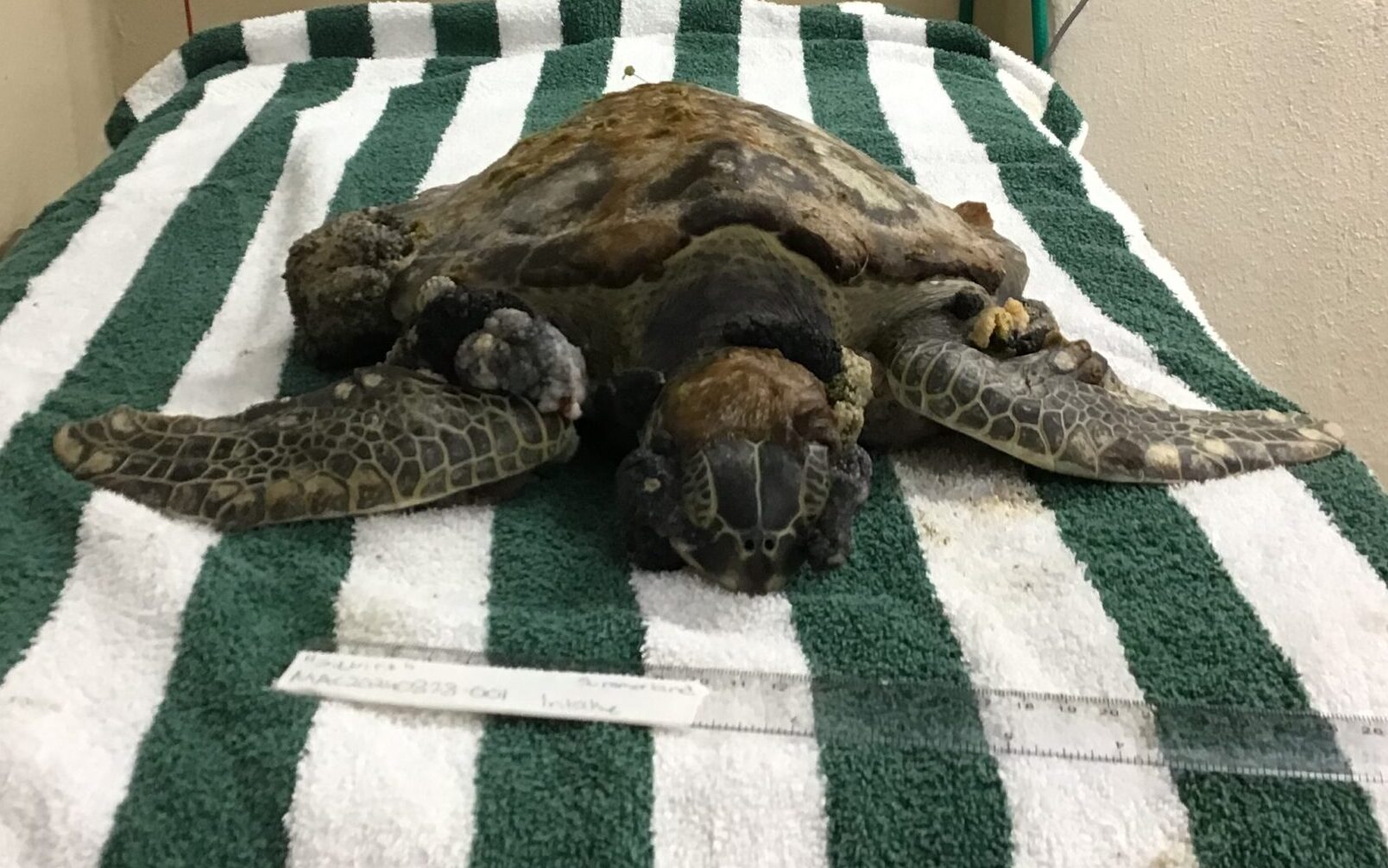
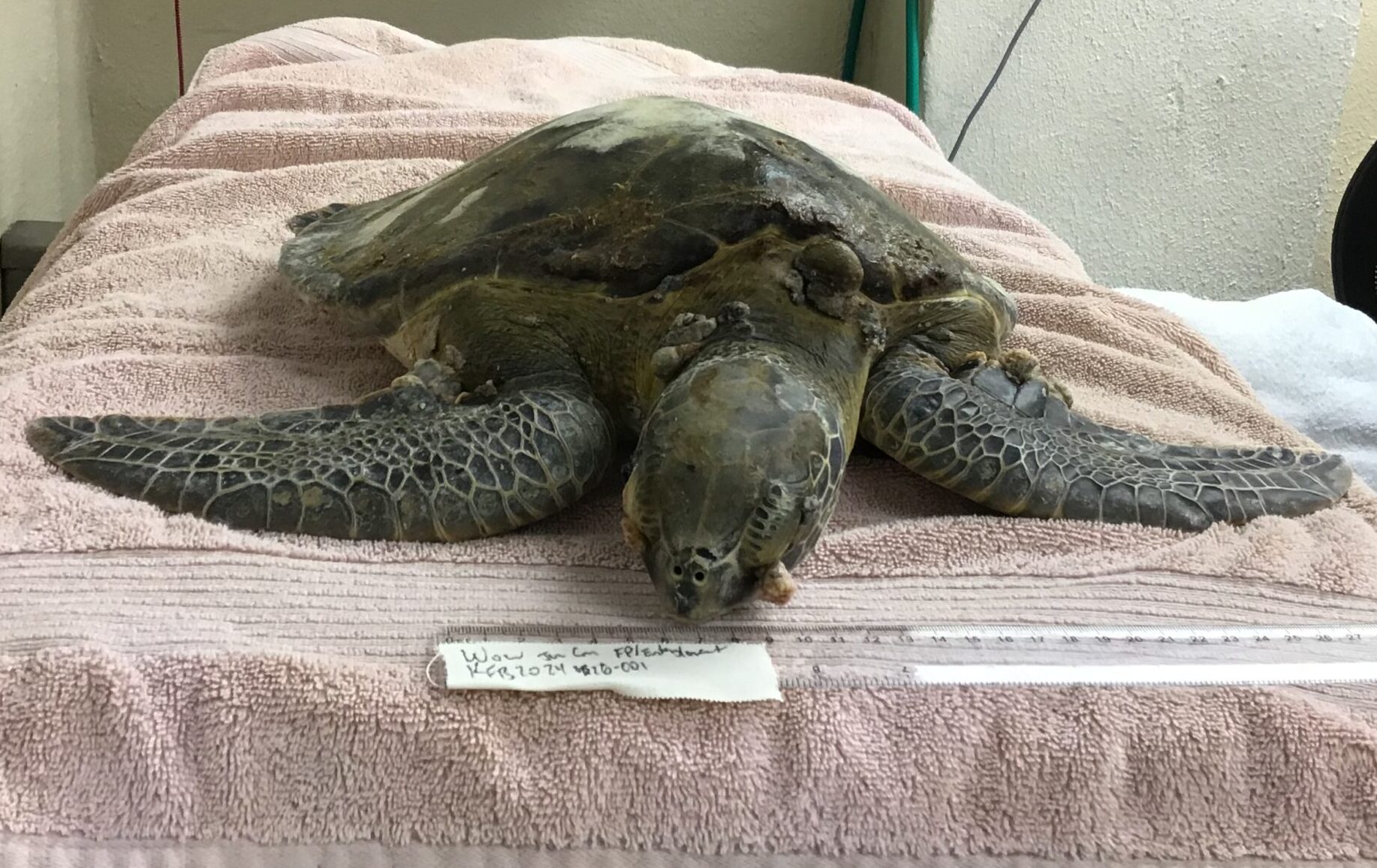
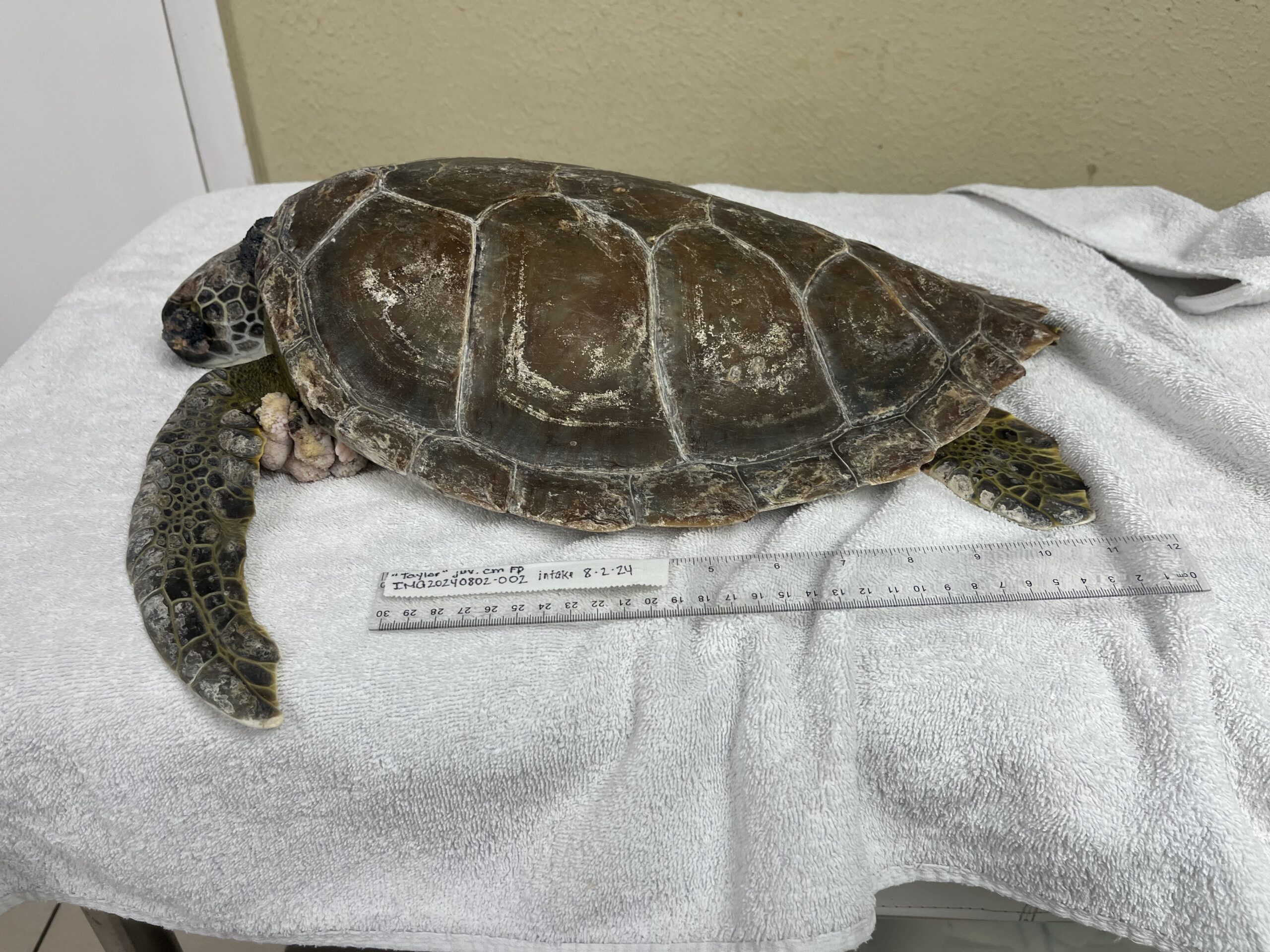
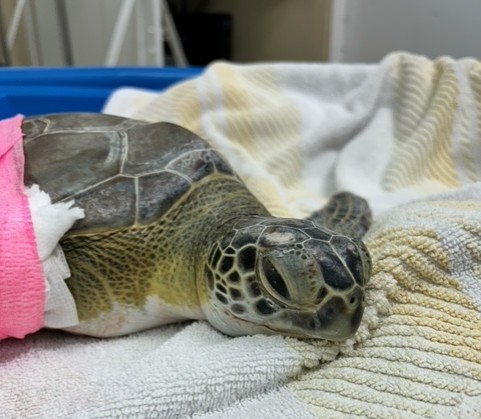
A juvenile Green Sea Turtle was rescued aprox 7 miles North of Duck Key. The small turtle has numerous fibropapilloma tumors affecting all flippers and the eyes. Surgery will be performed to ensure no internal tumors are present (by endoscope) and external tumors will be removed by laser and radio scalpel.
Lisa with Turtle Hospital Administrator, Ryan Butts.
JUNE 23, 2008
Smitty, a sub adult Loggerhead Sea Turtle, was released just North of the Seven Mile Bridge in Marathon. Admitted in January 2008, the turtle had been found floating and was unable to dive. Tests indicated an infection causing the problem and treatment was antibiotics and vitamins.
Participating in the release was Congresswoman Ileana Ros-Lehtinen and Turtle Hospital Director Richie Moretti.
The release was done from a US Coast Guard vessel.
And Smitty was last seen headed out to sea.
June 17, 2008
Cuda, a juvenile Kemp’s Ridley Sea Turtle, was admitted to the hospital in March 2008. The small turtle had nylon line wound around the base of one flipper and the line was attached to a plastic float. (See archives March 2008 for rescue details). The damaged flipper was saved by performing daily physical therapy to stimulate blood flow and exercise damaged muscles.
Turtle Hospital staff, Micah Rogers, returning Cuda to the water. The release was performed North of Long Key.
June 8, 2008
Two sub adult Green Sea Turtles were released aprox 8 mile North of Marathon.
Agnes had been hit by a boat and suffered a number of prop cuts to her head and shell (see archives February 2008 for rescue details). Turtle Hospital staff Tom Luebke and Dr Kevin Fitzgerald (Animal Planet Emergency Vet) ease her into the Gulf.
Rachel had undergone surgery to remove external fibropapilloma tumors and was held for a year to ensure no re-growth.
June 8, 2008
Dr Doug Mader, staff from the Marathon Veterinary Hospital, accompanied by Dr Kevin Fitzgerald (Animal Planet Emergency Vet) and Turtle Hospital staff performed several procedures today.
Snoop Riley, an adult Kemp’s Ridley Sea Turtle had an endoscope process to inspect for internal fibropapilloma tumors. This turtle has had external tumors removed twice before and recently another re-growth was found on the front flipper. A biopsy was performed on a suspicious area of the liver and the external tumor removed.
The endoscope entry points are closed by stitches
Hale, a juvenile Green Sea Turtle had already undergone a front flipper amputation, endoscope and removal of several large external tumors. Today’s surgery was to remove the remaining external tumors. The turtle was required to be anesthetized during the procedure and is connected an anesthesia machine that provides an adjustable mixture of “gas”, oxygen and air, as required.
Both turtles were kept out of water overnight and are doing well after being placed back in the pool.
June 2, 2008
Two Hawksbill Sea Turtles were released near the Contents Keys. Fito (a post hatchling) had been found floating in a high boat traffic area at Ocean Reef in Key Large and Niles (a juvenile) was from Niles Channel near Summerland Key. The Contents Keys area provides a shallow reef system with coral rock ledges and a variety of sponges which makes it an ideal habitat for the small Hawksbills.
Turtle Hospital Staff were taken out by the U.S. Fish and Wildlife Service which oversees the area Wildlife Refuges.
Officer Steve Berger releasing Niles.
Turtle Hospital Staff Tom Luebke releasing Fito.
June 1, 2008
A post hatchling Hawksbill Sea Turtle was found on the shore of Key Colony Beach. The small turtle was very emaciated and weak. Staff administered fluids which greatly improved the condition. The turtle has been placed in a tank, is swimming strongly and is eating well.
TREY Release
May 31, 2008
Trey is a juvenile Green Sea Turtle that had several surgeries to remove external fibropapilloma tumors and endoscope inspection to ensure there were no internal tumors.
Waiting a year after the last surgery (to ensure there are no re-growths), Turtle Hospital Staff performed the release approximately 12 miles North of Marathon.
May 30, 2008
Peter is a juvenile Loggerhead Sea Turtle that was found floating in a boat basin off of Stirrup Key in Marathon, January 2008. Blood analysis identified an infection which was treated with antibiotics.
With successful rehabilitation, the release was done just North of the Seven Mile Bridge. Participating in the release was Florida Governor Charlie Crist, Keys Mayor Mario Di Gennaro, chairman of the FWCC Rodney Barreto, Turtle Hospital director Richie Moretti and Turtle Hospital administrator Ryan Butts.
And with a splash, Peter returns to his element.
And quickly swims away.
The Turtle Hospital has recently installed a “Web Cam” which allows real time viewing of activity in the main pool. The camera view shows the area where feeding takes place in the morning and periodically during the day.
(Sample Image)
Access the live Web Cam by clicking on “Turtle Enclosure” under the “Turtle Hospital Webcam” heading located on the left side of the main screen.
The Web Cam was made possible by a generous donation.
On May 18, 2008 the annual Super Powerboat Grand Prix was held in the area waters in Marathon.
To ensure the boats (which can reach speeds in excess of 100 mph), don’t harm Sea Turtles or Marine Mammals, the Turtle Hospital coordinates inspection and monitoring of the race course by helicopter before, during and after the event. The “spotters” in the helo have the ability to hover over an animal on the race course (alerting and diverting the boat operators) or even stopping the race. The spotters are staff from the Turtle Hospital and Dolphin Research Center. The use of helicopters to keep the species safe has been employed for the last seven years and is also utilized during the Key West boat races.
Pictured above are Turtle Hospital Administrator, Ryan Butts and Turtle Hospital Education Coordinator Pat Thomson.
Hook (May 25, 2008)
A juvenile Green Sea Turtle was found floating in Vaca Cut in Marathon and taken to Captain Hook’s Marina. The turtle had been hit by a boat prop which resulted in a deep cut across the top of the turtle’s head.
Additionally, the turtle was covered with fibropapilloma tumors. The tumors were so severe that the rear of the shell was deformed.
Examination by Dr Mader’s staff determined the prop cut had damaged the brain and there would be no chance of recovery. After euthanasia, necropsy reveled a number of internal fibropapilloma tumors which would not have been treatable.
Adler (May 18, 2008)
A family was returning from a day of fishing to their home on Flying Cloud Avenue in Big Pine Key and found a juvenile Green Sea Turtle floating in the canal behind their house. Turtle Hospital staff were notified and picked up Adler (named after the family’s daughter).
The turtle was extremely emaciated and covered in fibropapilloma tumors, including the eyes. Despite best efforts by staff, the turtle was so weakened it did not respond to feeding or treatment and died several days after being admitted.
Sancho (May 20,2008)
Kayakers at Bahia Honda State Park were concerned when they saw a 124 pound Loggerhead Sea Turtle floating. They contacted Park Rangers who in turn contacted the Turtle Hospital. Staff responded and swam out about 20 yards off shore and brought in the turtle that was unable to dive. Sancho (named after one of the kayakers) is being treated for an infection.
Niles (May 17, 2008)
Snorkels found a juvenile Hawksbill Sea Turtle in Niles channel. Concerned that it was missing a front flipper and was not very active, they brought it to the Turtle Hospital. Niles is currently being evaluated and monitored for food intake and mobility ability.
Cudjoe (May 17, 2008)
Cudjoe Key resident, Jim Worrell, was heading out from his home to do some fishing. In Bow Channel he spotted a turtle that was not acting normal. The 107 pound Loggerhead Sea Turtle was floating on the surface and when approached would try to dive but was unable to get under. Jim drove his boat back home and contacted the FWC who in turn called Ryan Butts, the Turtle Hospital administrator. Ryan happened to be in the area, on his day off, and met Jim who took him out to the turtle. Rescuing the turtle was a bit of a challenge as it would swim away when approached by the boat and the large net typically used for this situation was back at the hospital. Ryan was able to jump off the moving boat and manually capture the animal.
With help from his girl friend, her sister and Jim, they were able to get the turtle on to the boat. Staff picked up the turtle in the ambulance and processed it back at the Turtle Hospital. Evaluation of the X-rays indicate a possible lung infection which would cause the floating problem.
While Jim gave up time from fishing, he does get bragging rights for catch of the day.
JPK (May 2, 2008)
Found at the canoe beach in John Pennekamp State Park in Key Largo, a very emaciated juvenile Green Sea Turtle was picked up by Park Rangers. The turtle is very weak and is being kept out of water unless monitored by staff. With no interest in offered food, daily “force feedings” will be performed in addition to every other day antibiotic, vitamin injections and fluids.
Update May 5, 2008
Sadly, JPK did not make it. Necropsy reveled damaged and scarred intestines that were unable to process or pass food. The damage was most likely caused by ingestion of fish line or plastic
MARK (April 28, 2008)
Found floating near John Pennekamp State Park in Key Largo, this sub adult Loggerhead has a severely impacted intestine.
It would appear from the X-rays that the turtle has been eating sponges or seaweed. The blockage is being treated with laxatives and enemas.
Update May 2, 2008
The material impacting the intestines has been identified as Spiny Sea Urchins. Fragments of spines and shells have been passed
Update May 19, 2008
Mark did not make it. The intestine blockage was so sever that it had affected other organs.