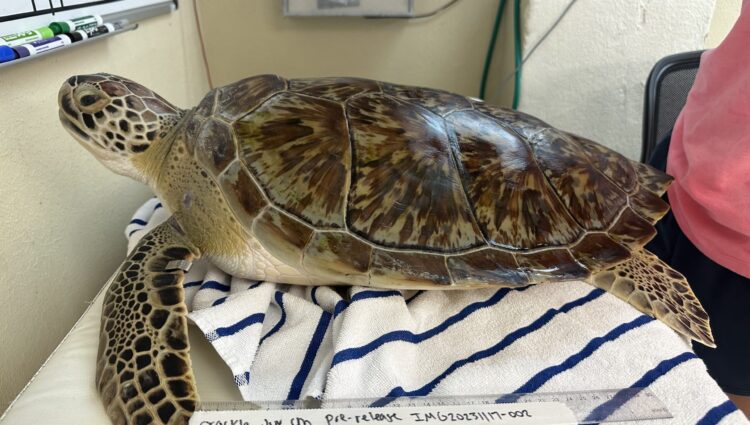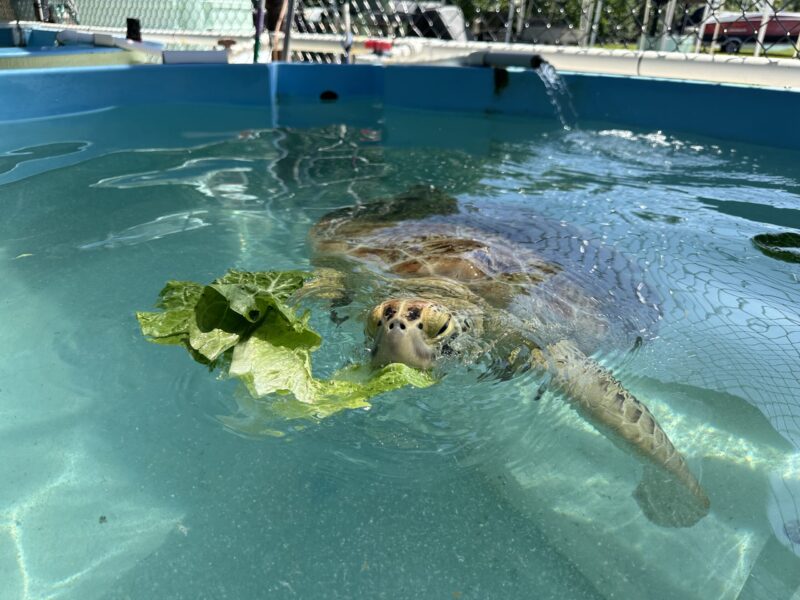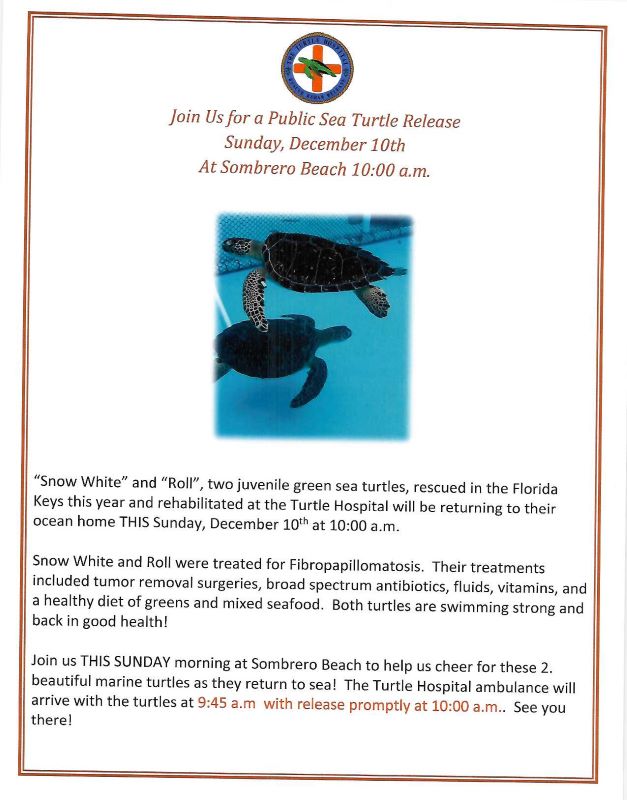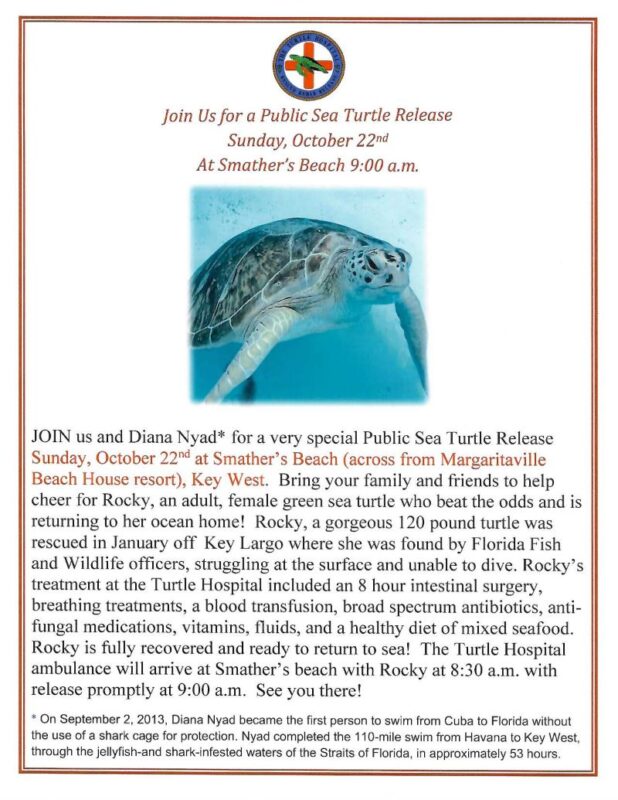
The Turtle Hospital would like to sincerely thank The Bouchard’s for their generous donation of surgical equipment. Turtle Hospital volunteer veterinarian Dr. Doug Mader has had a 30 degree rigid endoscope on his “wish list” for a very long time. This expensive piece of equipment would allow Dr. Mader to see internal tumors more clearly. In the fight against Fibropapillomatosis, an internal examination is the first step for every patient admitted with the virus. Internal tumors, which grow on the vital organs, are currently untreatable. Luckily, it’s estimated that less than 10% of patients admitted with the virus have them internal.

Thank you Bouchard Family!

The Turtle Hospital would like to sincerely thank Captain Spider for helping to raise money for our current 43 sea turtle patients! Long time local Captian Spider hosts a casting call twice a week in Marathon at several different bars and restaurants in the area. The game involves casting a line with a weight towards different colored targets in the water. Each target is worth a certain amount of points. The winner chooses from several great prizes but each player knows the small $5 donation to play this fun and addictive game helps benefit a local charity or non-profit. In two of the Captain’s latest casting calls nearly $300 was raised to help benefit The Turtle Hospital.

Thank you!

2010 has been an incredibly difficult year for The Turtle Hospital and Florida’s wildlife. In January, when temperatures plummeted into the thirty’s, 5,000 sea turtles stranded throughout the state. Of those, 188 were rescued and treated at The Turtle Hospital. The Turtle Hospital has recovered from the cold stun crisis, but with the impending hurricane season almost upon us, the Gulf of Mexico oil spill has potential to  cause more damage than anything the hospital has faced in the past.

In preparation for the worst, emergency tanks (used during hurricanes and during the cold stun) are being tested. The seawater that feeds the treatment tanks and saltwater pool inside the enclosure is pulled directly from the bay. If oil contaminates the bay there will be no access to outside seawater or circulation inside the enclosure for our patients. Therefore, for the animal’s safety, the sea turtles will have to be moved into two 36,000 gallon hurricane relief tanks located behind the hospital. These tanks can be filled with seawater directly from the bay, but once a valve is closed the tanks operate on a closed recirculating system. Large sumps and protein skimmers clean and filter the water. Patients that are seriously sick or injured will be moved inside the hospital where they can be monitored and treated.

Exxon
(Pictured Above: Exxon, a post hatchling Green sea turtle, was rescued December 28th 2008 found covered in oil. Mayonnaise was used to remove the oil and Exxon was eventually released.)

If the oil spill reaches the Florida Keys, The Turtle Hospital will be prepared to assist the community and local wildlife. Items necessary to clean and remove oil, such as Mayonnaise and Dawn soap, are being purchased to respond to any sea turtles or other marine life affected by the oil. Mayonnaise is safe, non-toxic and effective in cleaning sea turtles coated in oil. In addition, The Turtle Hospital will also need haz-mat suits, a shade cloth for the hurricane tanks and large quantities of synthetic sea salt for mixing artificial sea water.

For those interested in volunteering their time to assist in a possible clean-up visit Keys Spill for information.

For more on how The Turtle Hospital is preparing for disaster visit: http://www.justnews.com/video/23470002/index.html

UPDATE May 29th:

Turtle Hospital staff continues to monitor the BP oil spill and remains in contact with DEP (Department of Environmental Protection), BP (British Petroleum) and FWC (Florida Fish and Wildlife.) For now forecasts state that a light sheen of oil is near the loop current but should dissipate before reaching our coasts. All staff members of The Turtle Hospital have taken the required courses for post oil clean up and continue to remain on high alert. No sea turtles in Florida Keys waters have been reported injured from oil contamination. For now we encourage travelers to visit the Florida Keys and we continue to offer our daily guided educational programs of The Turtle Hospital at 10am, 1pm and 4pm daily.

For updates and daily trajectories visit: http://response.restoration.noaa.gov/topic_subtopic_entry.php?RECORD_KEY(entry_subtopic_topic)=entry_id,subtopic_id,topic_id&entry_id(entry_subtopic_topic)=809&subtopic_id(entry_subtopic_topic)=2&topic_id(entry_subtopic_topic)=1

UPDATE 09/01/2010

urtle Hospital staff continues to monitor the BP oil spill and remains in contact with Department of Environmental Protection (DEP), British Petroleum (BP) and Florida Fish and Wildlife (FWC). There are currently NO reported signs of oil in Keys waters and no sea turtles have been contaminated by oil in the keys. The Turtle Hospital does not have any patients in treatment currently due to oil.

To date, nearly 700 sea turtles have lost their lives due to oil contamination, of those nearly 80% were critically endangered Kemp’s Ridleys. However, groups like Inwater Research Group, a non-profit sea turtle research organization, have successfully rescued 509 live sea turtles which have been taken to rehabilitation facilities like the Audubon Aquarium in Louisiana.

Here are some current statistics from Inwater:

Turtle                                      Species                 Alive       *Dead      Total
Green turtle                       (Chelonia mydas)          169          23          192
Hawksbill turtle             (Eretmochelys imbricata)     15            1           16
Kemp’s ridley turtle         (Lepidochelys kempii)       305          412         717
Loggerhead turtle                (Caretta caretta)            20           51          71
Unknown turtle species                                            0           39          39
TOTAL                                                                 509          526        1035

* These are turtles that we found offshore near the spill site as of 8/16/10.

They are still currently looking for impaired sea turtles in offshore areas out of Destin, FL and Orange Beach, AL with NOAA and Unified Command.

For more information visit Inwater at: Inwater

Currently as we prepare our facility, we continue to keep our thoughts with the wildlife that is being affected by this disaster in the gulf.

For now we encourage travelers to visit the beautiful Florida Keys and we continue to offer our daily guided educational programs of The Turtle Hospital at 10am, 1pm and 4pm daily.

Visit Keys Spill for more on how you can become a certified oil-spill clean-up volunteer and stay updated on current information as it becomes available.

For more information and for daily trajectories visit: NOAA

Wyland, famous for his amazing underwater paintings and murals, met with Turtle Hospital staff and a little Loggerhead named Scooter at his gallery in Islamorada and Key West. The Turtle Hospital was personally invited to the “Meet The Artist” event where staff was able to educate guests on sea turtles and the impact we as humans have on the ocean. During the event, Wyland created an original painting of our beautiful educational Loggerhead, Scooter.

wyland-1-e.JPG

This original one of a kind painting was donated by Wyland to The Turtle Hosptial. It is valued at $3,750. The Turtle Hosptial will be selling the painting for its estimated value with all proceeds benefiting The Turtle Hosptial. 100% of the proceeds will be used for the medical and surgical care our current 51 sea turtles desperately need.

If you are interested in this fabulous original piece of art by Wyland and would like to help support The Turtle Hospital please contact Turtle Hospital at 305-743-2552 or at turtlehosp@aol.com.

wyland-2-e.JPG

Thank you for  your interest and support!

wyland-3-e.JPG

bolin-e.JPG

Bolin, a very small juvenile Green sea turtle, was rescued by The Coast Guard in Islamorada. It appears as though Bolin was either struck by a propeller or attacked by a predator. Although she escaped with her life, Bolin is missing part of the rear of her shell and her left rear flipper. The injury appears to be fairly recent but has already begun healing since she has been in our care. Currently staff is treating the small Green sea turtle with antibiotics to prevent infection and cleans and debrides the wound daily. Even though she is missing part part of her shell and one flipper, Bolin will be able to return to her home in the sea once the wound has healed.

UPDATE May 1st:

Bolin is released!

bubba-e.JPG

Bubba, a 93 pound sub-adult Loggerhead, was rescued March 27th by good samaritans Buddy & Mary Ellen Norris near No Name Key. (Bubba is pictured above with his rescuers). Bubba was found struggling to dive and brought in shore where Turtle Hospital staff brought Bubba back to Marathon via Turtle Hospital ambulance! Preliminary x-rays ruled out impaction and blood work was sent to a lab. As it turns out, Bubba has a minor infection. Since he has begun antibiotic treatments, Bubba gives staff a hard time by opening his mouth and trying to bite when given an injection! In only one week Bubba appears less bouyant and more active. Staff expects a full recovery!

UPDATE April 11th:

Bubba is no longer floating! He is able to remain at the bottom of his treatment tank. This means that his infection is already clearing and Bubba is well on his way to recovery!

Turtle Hospital staff would like to thank Buddy and Mary Ellen for their generous donation. This donation will be used to help provide the food and antibiotics Bubba needs!

UPDATE May 1st:

Bubba was released from the beach at Coco Plum in Marathon!

tilly-3-e.JPG

The Turtle Hospital in Marathon would like to invite residents and guests to the Keys to participate in the release of “Sharon”, a Loggerhead sea turtle, when the turtle is returned to her ocean home on Thursday, March 25th. Sharon was rescued from the Bahia Honda area in December with a severe infection. After several months of antibiotics and rehabilitation, Sharon is now ready for release. Due to a generous donation from Sharon’s rescuers, the turtle will be outfitted with a satellite tag to track her movements throughout the Keys and the Caribbean. This will be great educational tool for sea turtle conservation where classrooms and individuals can log on to the Turtle Hospital’s website and follow the turtle’s migration over the next year. The event will take place at Bahia Honda State Park on Thursday, March 25th at 11:00 am. To learn more about Sharon’s release call 305-743-2552.

hana-lei-e.JPG

“Hanalei” is a young Green sea turtle that was rescued Monday afternoon south of Marathon. The young turtle was rescued by concerned boaters that recognized the turtle was in distress. After getting the turtle on board with little effort, it became apparent that Hanalei had sustained a propeller strike behind the right eye. Although it appears to be shallow, the turtle is not yet able to open the eye. The turtle is now in the safety and security of the Turtle Hospital, where she will recover without having the risk of being eaten by predators or struck by another boat. The Turtle Hospital would like to thank Steve Arnett and friends for taking the time to rescue this young injured turtle and bring it to the Turtle Hospital for medical care.

UPDATE May 14th:

Hana Lei’s condition had not improved until recently. Dr. Mader consulted with Turtle Hospital staff and performed and endoscopy to check the body cavity and lungs for any suspicious findings. Hana Lei, in addition to the propeller wound on her head, also has fungal pnuemonia and septecimia. Treatment will be anti-fungals, antibiotics, vitamins and daily tube feeding.

leoni-e.jpg


The Turtle Hospital received a call Monday morning of a sea turtle floating lethargically in a canal in Islamorada. The subadult Loggerhead was slowly paddling up and down the canal, unable to dive. Within a matter of time, the turtle would have likely been struck by a boat. Concerned residents and fishermen Mike Walter Sr. and his son Mike Jr. escorted Turtle Hospital staff to the distressed animal. The turtle attempted to dive but quickly surfaced, bobbing like a cork. A quick swoop of a net and “Leoni” was rescued and brought on board the boat, after which she was transferred quickly to the Turtle Hospital for medical care. Unfortunately, Leoni had suffered an old boat strike injury which damaged the back of her shell. Although healed, the 120 pound turtle will be placed on antibiotics for infection and assessed for swimming ability. The Turtle Hospital would like to extend a special thank you to Mike Walter Sr. and Mike Walter Jr. for their efforts in saving this turtle’s life.

dscn1629-e.JPG


The Florida Keys typically provide year round warm weather and beautiful clear blue waters that attract residents, tourists and wildlife alike. Many juvenile sea turtles returning from the oceanic stage of their life spend time in shallower areas around Florida‘s coast foraging for food in the traditionally warmer waters. It is this exact behavior that has left them susceptible to the extreme cold front staying on top of the Southeast region.

Residents and visitors bundle up beneath jeans, sweatshirts and hats to protect their bodies from the chilly conditions outside. As reptiles, sea turtles are left exposed to the elements unable to regulate their body temperatures and are at high risk of succumbing to any dramatic change in temperature. Florida Fish and Wildlife (FWC) and sea turtle rehabilitation facilities around the state are experiencing first hand what devastating effects the plummeting temperature is having on these already endangered sea turtles.


dscn1706e.JPG

This crisis began January 6th, 2010, after 92 sea turtles, mostly juvenile Greens, were found at Mosquito Lagoon off of Meritt Island, Florida. These sea turtles appeared dead as their nearly frozen bodies remained motionless in a state of suspended animation. Unable to regulate their buoyancy or metabolism, these sea turtles began popping up at the surface floating like corks. The only movement made was caused by the passing waves. Thanks to rescue efforts organized through FWC these 92 sea turtles were rescued but it became apparent that the next obstacle was finding medical facilities to quickly and appropriately care for them. 12 of the 92 sea turtles rescued that day were also suffering from a virus called Fibropapilloma. This virus causes tumor like growths that leave the afflicted animal debilitated. Most sea turtles suffering from the virus succumb to eventual starvation, boat hits or shark attacks from impaired vision. As one of only three facilities in the state of Florida that can admit and treat sea turtles with Fibropapilloma, The Turtle Hospital quickly answered the call for help, despite an already full facility patient load of 50 sea turtles.


cold-stun-e.JPG


The Turtle Hospital opened its doors to these 12 cold stunned sea turtles with Fibropapilloma for treatment. All 12 sea turtles were in critical condition and required 24 hour care and monitoring. Staff immediately began heating the Emergency Room and Operating Room inside the hospital in preparation for these sea turtles. To prepare for this sudden influx of sea turtles, The Turtle Hospital rushed to acquire additional supplies such as temporary holding pools, heat lamps, extra fluids and medications. Each cold stunned sea turtle was placed in an individual pool beneath towels to begin slowly raising their core temperature. The turtles required antibiotics, warmed fluids, x-rays, blood work (which was sent to a lab for additional testing) and emergency medication to keep their hearts beating. In addition to their daily care, once strong enough, all 12 sea turtles require a surgical procedure to remove the external Fibropapilloma tumors.


dscn1695e.JPG


Unfortunately, this is the beginning of what could turn out to be a catastrophic event for Florida‘s sea turtles. After the first mass stranding on January 6th, the following day 183 sea turtles stranded in Mosquito Lagoon and 100 near the panhandle. As of January 9th, over 1,000 sea turtles have stranded state-wide. Experts believe that with the cold weather remaining over Florida throughout the next week, the number of cold stranded sea turtles could rise to nearly 1,000. In addition to the current 64 patients being treated at the facility, many more sea turtles will be admitted by the end of the cold front. Each sea turtle will require food, medication and surgical procedures, in addition to a temporary treatment tank, individual heat lamp and continual care.

 dscn1748-e.JPG

As a 501(c)(3) non-profit facility The Turtle Hospital relies on the generosity and compassion of the public to support its patients. There are many things people can do to help out. Admissions fees for the guided educational tours, purchases from our gift shop and online store, memberships and adoptions all directly fund The Turtle Hospital through a crisis such as this. Each purchase or donation will provide the medical care these animals desperately need. The Turtle Hospital can not do this without your continued support.

To help the cold stunned sea turtles please click the following link: Donate

dscn1737-e.JPG

UPDATE: January 11th 2010, The Turtle Hospital admitted 56 cold stunned sea turtles. Most of these sea turtles were Greens, however several were also large Loggerheads and juvenile Hawksbills. As of January 12th 2010, The Turtle Hospital had rescued 54 more. The following day, January 13th 2010 an additional 52 cold stunned sea turtles were rescued from the cold waters inside the bay.


UPDATE: January 13th 2010:

Nearly 200 Cold Stunned sea turtles have been rescued in the 3 day span. This is more than The Turtle Hospital admits in an entire year.

steve-2-e.JPG

Charter Boat Captain Steve of The Galloping Ghost in Key West is a true Sea Turtle Rescuer! On Saturday, November 21st Steve was out flats fishing with a client when he noticed a small turtle floating by. He was able to reach out and pull the tired and weak turtle on his boat. This was the first time he would ever rescue a sea turtle in distress but not the last! Turtle Hospital staff met Steve on Stock Island to pick up the small turtle he named Melissa, after his wife. Melissa is suffering from Fibropapilloma, a virus that causes tumor-like growths on sea turtles. Amazingly, only a few short days later on November 23rd, he was out fishing again and brought in a very big catch! A 210 pound adult Loggerhead sea turtle!

steve-e.JPG

Named Stevie, this adult male Loggerhead sea turtle appears to have a shell infection. Stevie was so large that it took a fork lift to move him from the boat to The Turtle Hospital ambulance! Back at The Turtle Hospital, Stevie is being treated with antibiotics as well as a topical anti-biotic to prevent further damage from the infection. We expect a full recovery from Stevie. Melissa, the first turtle rescued, is awaiting an endoscope to check for internal tumors. As long as Melissa has no internal tumors, staff from The Marathon Veterinary Hospital will remove her external tumors. She will then remain here at the hospital for one year under observation to ensure she has no re-growths.

Stevie the Loggerhead, Melissa the Green and The Turtle Hospital Staff would like to extend a special Thank You to Captain Steve for saving the life of not just one but two endangered sea turtles!

UPDATE December 10th:

Good news! Melissa has no internal tumors! Surgery will be scheduled to remove the external tumors. Stevie also continues to show improvement but is being treated with antibiotics to continue fighting the infection.

UPDATE May 2nd:

Stevie, a 200 pound adult Loggerhead, was rescued in November by Captain Steve of The Galloping Ghost. Suffering from an infection, the large male sea turtle was stuck at the surface unable to dive. Once at The Turtle Hospital, treatment included antibiotic therapy, vitamins and a little rest and relaxation.

Five months had passed since his rescue and Stevie was feeling like a brand new turtle! Once the infection cleared Stevie was more than ready to return to his ocean home. On a beautiful Sunday evening, just before sunset, a crowd of more than 300 fans gathered to wish him well and say goodbye.

Stevie beach release

The Turtle Hospital would like to sincerely thank all who attended the release!

See The Turtle Hospital and the Florida Keys as you’d never imagined! You can now view The Turtle Hospital in high resolution 360 degrees!

Florida Keys 360, Inc. shares with you our Florida Keys home as if you were here with us. Experience the coral reefs of the Florida Keys as if you were actually snorkeling or scuba diving with us in our clear warm tropical waters. Fly down the Florida Keys Highway US1 from Key Largo to Key West as if you were one of our local pelicans. Spend some time on our tropical Florida Keys beaches and live some our our unique one-of-a kind Florida Keys events as if you were right in the middle of the scene. Whether you fly, drive or arrive by boat, you will see Key Largo, Islamorada, Tavernier, Marathon, Big Pine and Key West as you have never seen them before. Welcome to our Florida Keys, and enjoy our world. This site is active and growing fast. Within the next several weeks aerial images of the entire Keys from Key Largo to Key West will be up, and new underwater locations are being added every few days. So check back every week and enjoy the Florida Keys”

To view The Turtle Hospital via Florida Keys 360 please follow this link: http://fla-keys360.com/do/48/turtle/hospital.html

Operating Room: www.fla-keys360.com/do/48/turtle/surgery.html

Education Center: www.fla-keys360.com/do/48/turtle/education.html

Rehab Area: www.fla-keys360.com/do/48/turtle/rehab.html

Last Sunday, we received a call regarding a turtle floating in a canal in Key Largo. The turtle was spotted promptly upon arrival; however catching the wily creature proved a bit more difficult. The 40-pound Green turtle was able to dive and evade capture for nearly an hour. Once captured and transported to the Hospital, it was determined that the turtle, named TC, had survived an incredible encounter with a large shark a few weeks prior. The turtle has a large semi-circular wound (approx 12 inches in diameter) on her left side.

TC continues to float, possibly due to an infection, but has made a remarkable recovery thus far. She will remain in the care of The Turtle Hospital until she no longer floats and is able to stay at the bottom of the tank. She is an incredibly lucky turtle. She should make a full recovery, and she will always have a really cool scar to show off to the other turtles!

dscn5082e.JPG
Update August 31st 2009:

Hobie TC, although recovered from the shark attack, continues to float despite treatment with antibiotics and laxatives. Therefore, TC has been moved to the main area of our 100,000gl saltwater swimming pool. TC may be a bubble-butt which would leave her permanently floating.  There currently is no cure for this syndrome, so TC may not be released.

UPDATE 09/01/2010

Hobie TC has moved to a new home at The Living Planet Aquarium in Utah!

Earth Day at Bahia Honda, Ocean Celebration at Dolphin Research Center, Science Day at Stanley Switlick. The Turtle Hospital is always looking for ways to renew our commitment to raise awareness about human-caused dangers that sea turtles face. We treat an average of 100 sea turtles per year. These turtles have been hit by boats, entangled in fishing gear, disoriented by lighting near their nesting beaches, or sickened by pollution or ingested trash. All of these dangers can be prevented by simply acting responsibly toward the environment. But many people are unaware of how their actions affect sea turtles and we’re aiming to change that.Every Spring is all about education, education, education!Monroe County Public School classrooms are invited to visit our facility free of charge in the month of May to learn about our turtles, the injuries they have sustained and how we can help them get back on their flippers and swimming off strongly on their release day! We also dedicate several of our Spring days to special events around the Keys that are developed to educate our many visitors and community members that are out and about enjoying the wonderful weather this time of year. So far we’ve been able to attend Bahia Honda’s Earth Day Celebration April 18th, Dolphin Research Center’s Ocean Celebration day April 30th, and Stanley Switlick Elementary School’s Science Day May 7th!

drced.JPG

Dolphin Research Center’s Ocean Celebration  

dscn4906e.JPG 

Stanley Switlick Elementary School’s Science Day  

If you missed us at these events and are unable to visit for one of our tours at the hospital, here are some easy suggestions to get you started helping sea turtles no matter where you are:

1. REDUCE packing that ends up in the landfill by buying in bulk

2. REUSE old containers and packaging from your every day purchases

3. RECYCLE all plastics, glass, and metals where facilities exist,

4. CLEAN UP- participate in and/or organize projects for roads, parks and beaches,

5. EAT SUSTAINABLY- buy only sustainably harvested seafood by participating in the Seafood Watch program (www.seafoodwatch.org)

    
The Turtle Hospital is based on WordPress platform, based on a design by Gx3.